

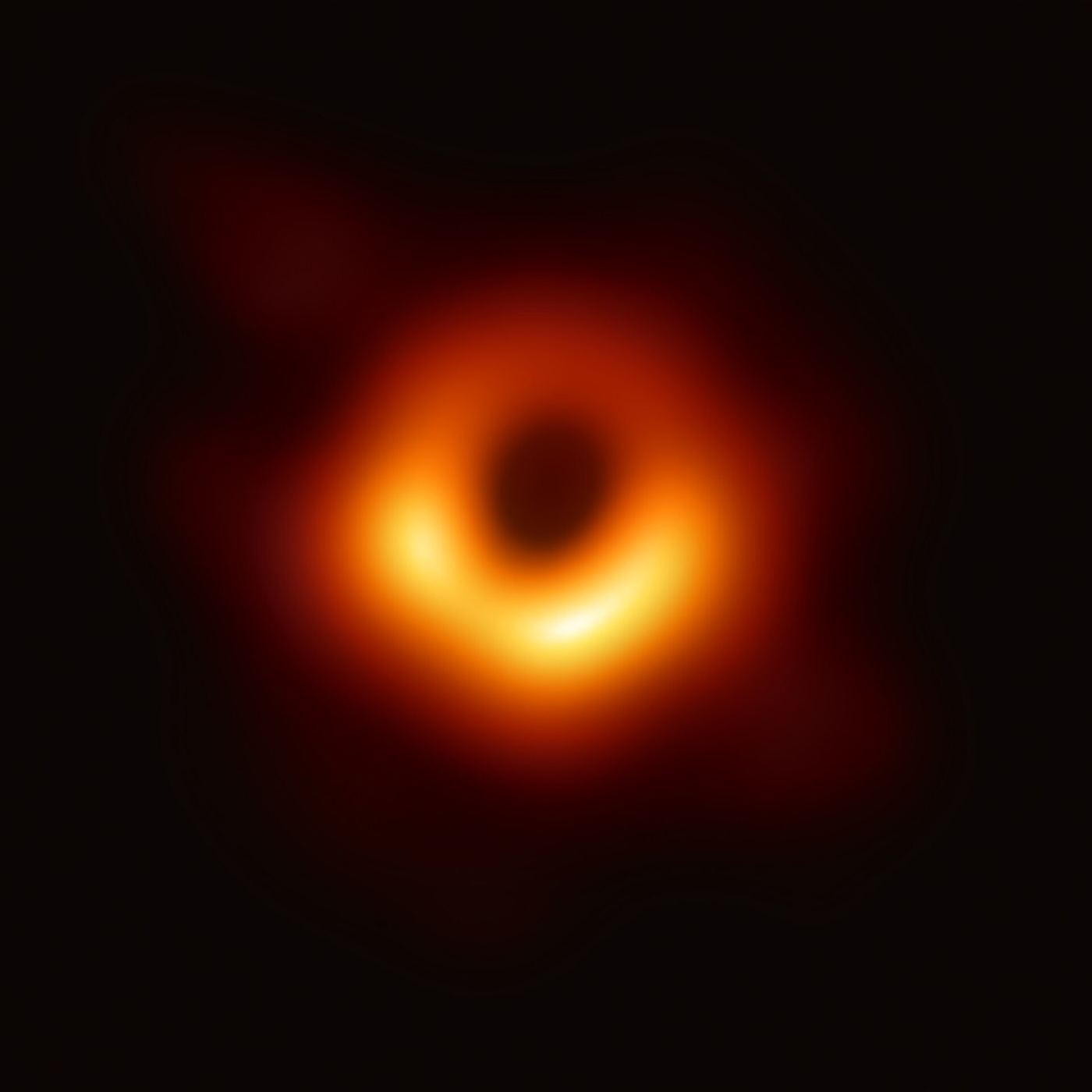
A black hole is a place where gravity has won completely. When a massive star dies, its core can collapse under its own weight until it is squeezed into a point so dense that nothing, not even light, can escape from it. The boundary of this region is called the event horizon, and anything that crosses it is lost to the outside universe forever. Black holes come in many sizes. The smallest form from single stars, while the largest, called supermassive black holes, sit at the centres of galaxies and weigh as much as millions or billions of Suns. The one at the centre of our own Milky Way is called Sagittarius A*, and astronomers have tracked stars whipping around it at astonishing speeds, their orbits revealing the invisible mass at the heart of the galaxy.
What the Evidence Shows
In 2019 astronomers achieved something long thought impossible: they photographed a black hole. Telescopes across the world were linked together to form a single instrument the size of the Earth, and the resulting image of the black hole in galaxy M87 showed a glowing ring of hot gas around a dark shadow, exactly as theory predicted. The picture confirmed ideas that had existed only in equations for a century, and later images revealed the magnetic fields threading the ring. Black holes also send out ripples in space itself, called gravitational waves, when two of them collide, and detectors on Earth now catch these faint tremors regularly. Each new observation tests our understanding of gravity, and black holes remain the most extreme laboratories in the universe. Reporting and analysis from sources such as National Science Foundation track the same developments, and specialists following the black holes bending light around them say the direction is now consistent across independent lines of evidence.
The Wider Context
The wider context is a research landscape in which replication and open data now decide reputations. Findings connected to the black holes bending light around them are being checked by independent groups with shared datasets, and the teams involved publish their methods in full so rivals can test every step. That discipline is slower than a headline cycle, but it is why results in this area increasingly survive first contact with scrutiny.
What Happens Next
What happens next in the story of the black holes bending light around them will be decided by follow-up work already under way: larger samples, longer observation and instruments that have not yet come online. The researchers involved are unusually united on one point, that the current results justify the next investment of time and money. Readers will not have to wait long for the first tests of that claim. You can follow related developments in our coverage of science.
There is a practical lesson in all of this for readers deciding what to do today. Start with the verified facts, be wary of anyone promising certainty, and prefer reversible steps while the evidence is still developing. Circumstances differ by country, income and personal situation, so general guidance should always be weighed against your own context before you act on it in any significant or lasting way.
